
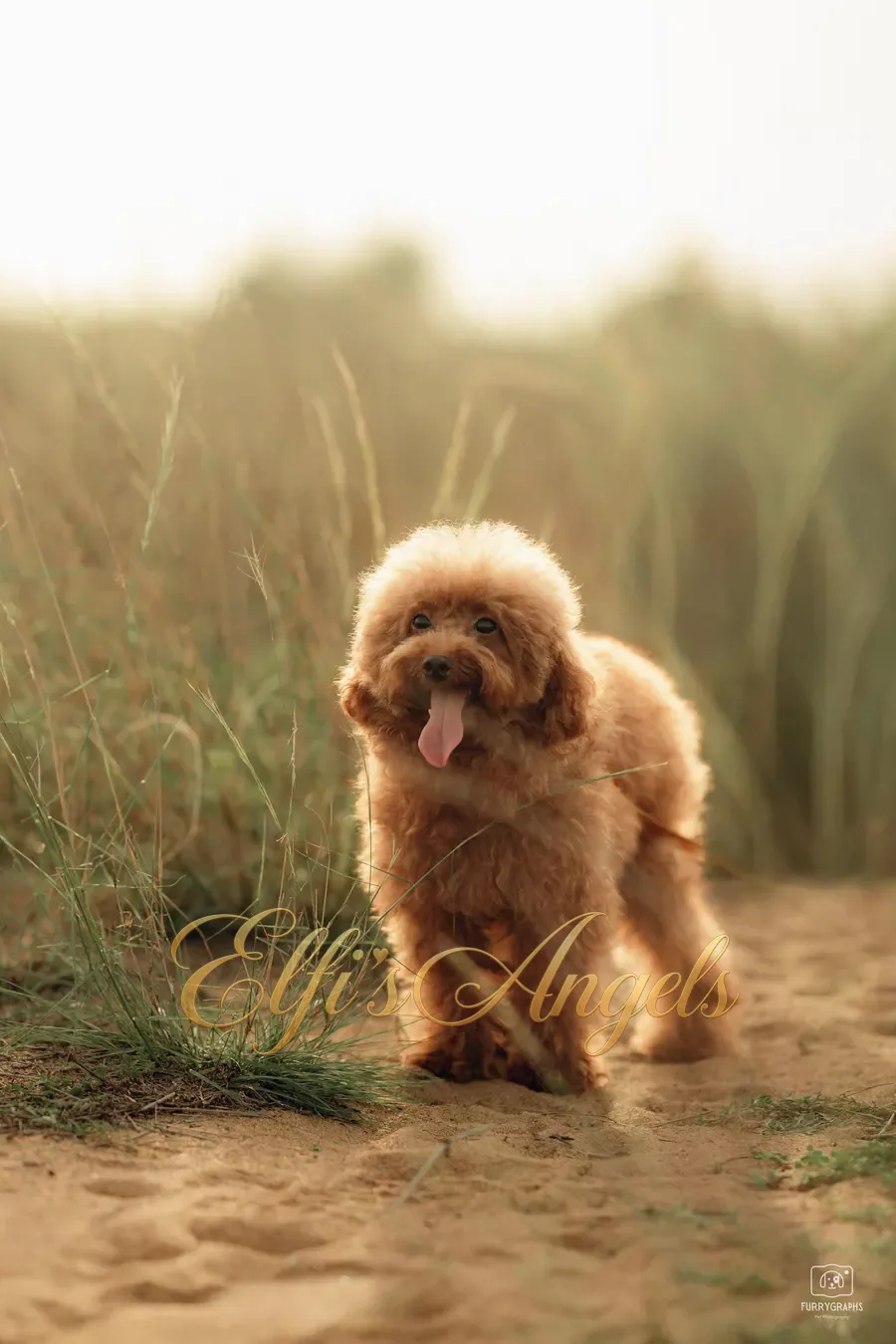
A Toy Poodle may fit neatly on your lap, but there is nothing tiny about the personality. These bright little dogs learn family routines quickly, love being involved and bring a playful spark to apartments, houses and villas.
At Elfi’s Angels, our Toy Poodle programme focuses on confident home companions in deep mahogany red, ice white and apricot. Here is the complete picture—from adult size and daily life to food, grooming and choosing the right home rhythm.
The quick answer
Start here
- Typical adult reference: up to 10 in / 25.4 cm at the shoulder and about 1.8–2.7 kg.
- A lovely fit for apartments and indoor homes when play, training, toilet access and companionship are planned.
- Quick to learn, affectionate with family and happiest when included in everyday life.
- The curly coat sheds very little around the home, but it does need regular combing and professional grooming.
Toy Poodle size and build
The AKC describes a Toy Poodle as no more than 10 inches (25.4 cm) at the shoulder, with a typical listed weight of about 4–6 lb (1.8–2.7 kg). Those figures are a breed reference, not a promise about an individual puppy’s adult weight.
A well-built Toy Poodle should look like a scaled-down Poodle rather than a fragile novelty: square in outline, alert, balanced and able to move freely. Very small puppies need protection from falls, rough play and accidental handling by children.
Temperament and intelligence
- People-oriented and affectionate with its familiar family.
- Quick to learn names, routines, cues and household patterns.
- Playful and athletic; many enjoy retrieving, scent games and trick training.
- Alert and sometimes vocal, so calm reinforcement and an early “quiet” cue help.
- Sensitive to inconsistent or harsh handling; short, positive sessions work best.
A little Elfi’s note: Breed tendencies are a starting point. Parent temperament, early socialisation, health and the receiving home shape the adult dog.
Is a Toy Poodle suitable for an Indian apartment?
Yes, a Toy Poodle can thrive in a flat, individual house or villa when the home provides a predictable routine. A 30-minute outdoor walk can be a useful daily anchor for many healthy adults, but it must be paired with indoor play, training, sniffing and companionship. Puppies need shorter, more frequent activity rather than one forced walk.
In hot or humid weather, walk in the cooler early morning or evening, carry water, test hot paving with your hand and stop if the dog is panting heavily, lagging or seeking shade. Indoor floor grip matters too: runners or mats can reduce slipping for a tiny dog.
Daily care in one view
| Need | Practical routine |
|---|---|
| Exercise | Age-appropriate walks plus several short play or training sessions. |
| Mental work | Food puzzles, scent searches, retrieving, tricks and calm-settle practice. |
| Coat | Comb at least every other day when kept short; daily attention for longer coat. |
| Potty | Frequent scheduled trips to one tray or outdoor spot; tiny bladders need realistic expectations. |
| Handling | Support the body when lifting and supervise all child and larger-dog interactions. |
Life with a Toy Poodle
The best home wants an involved companion, not a dog that is left alone for most of the day. It is ready to budget for professional grooming, teach house rules patiently and keep a tiny dog safe without preventing normal confidence-building experiences.
A Toy Poodle may be a poor match where young children will handle the dog unsupervised, where grooming is considered optional, or where barking, training and daily engagement cannot be addressed.
Children, older adults and other pets
A Toy Poodle can be affectionate with respectful children, but its small frame changes the safety rules. An adult should supervise every interaction. Children should sit on the floor, invite the dog to approach and never lift, chase, squeeze or disturb a sleeping puppy. A puppy pen gives the dog a child-free resting place.
With older adults, portability can be helpful, but an energetic puppy underfoot can be a trip risk. Use non-slip mats, gates and a predictable settling place. Introduce cats and larger dogs through barriers and short calm sessions; do not assume the smaller dog is automatically safe because it is friendly.
What a normal adult day looks like
| Time | Practical routine |
|---|---|
| Early morning | Toilet trip, a cool short walk or sniff, breakfast and a brief training game. |
| Working hours | Rest near the family, a food puzzle, planned toilet access and one short play break. |
| Evening | A second walk or indoor retrieve, five minutes of cues, combing or handling, then calm family time. |
| Before bed | Final toilet trip, water access and sleep in a familiar quiet place. |
A little Elfi’s note: Thirty minutes is not a magic number. Split activity across the day and adjust for age, weather, health and the individual dog.
Barking, clinginess and learning to stay alone
Toy Poodles notice doorbells, corridor sounds and changes in routine. Prevent alert barking from becoming a habit: reduce window access, reward quiet observation, teach a settle mat and avoid shouting back. If barking suddenly increases, first rule out pain, toilet urgency or fear.
Companionship is a breed strength, but the puppy should still learn safe independence. Begin with seconds behind a gate while eating a chew, return before panic and build gradually. Repeated screaming, drooling, frantic escape attempts or refusal of food when alone needs professional veterinary-behaviour guidance.
Food, teeth and a happy wellness routine
- Feed a complete diet labelled for growth during puppyhood; measure tiny portions accurately and count training treats.
- Toy puppies should not be fasted or placed on an adult weight-loss plan without veterinary direction.
- Build toward daily tooth brushing with dog toothpaste; small mouths can accumulate dental disease early.
- Ask about patella evaluation, an ophthalmologist examination and PRA-prcd DNA testing in the parents, which are among the breed-club recommendations for Toys.
- Discuss sudden weakness, trembling, repeated vomiting, diarrhoea, collapse or refusal to eat promptly with a veterinarian.
A little Elfi’s note: Continue regular veterinary care as your puppy grows into an adult companion.
Chennai heat, travel and small-dog safety
- Walk in the cool early morning or evening and avoid hot paving, parked cars and unshaded balconies.
- Use a well-fitted harness for routine walks; carry the dog only when the environment is unsafe, not as a substitute for confidence-building.
- Secure the puppy in a crate or tested vehicle restraint—never loose on a lap or seat.
- Block stairs and balcony gaps, remove access to recliners and heavy doors, and check where the dog is before stepping back.
- Do not encourage jumps from beds or sofas; use a ramp or lift with the body supported when necessary.
Typical adult size and ORIJEN Original daily quantity
| Adult height | Typical adult weight | Less active adult | Recommended starting portion | More active adult |
|---|---|---|---|---|
| No more than 10 in / 25.4 cm | About 1.8–2.7 kg | ¼–½ cup / 30–60 g per day | ½ cup / 60 g per day | ⅓–¾ cup / 40–90 g per day |
A little Elfi’s note: Our recommended ½ cup / 60 g is a practical adult starting portion for ORIJEN Original. Every number is the total for one full day, not one meal, and should be split into two adult meals. Other foods have different calorie densities and feeding charts, so their portions will vary.
The Elfi’s Angels difference
Our programme brings together thoughtful parent selection, imported and champion ancestry, home raising and the practical preparation a family companion needs.
Our puppies leave at about 10 weeks with clear KCI-related paperwork, familiar care information and direct handover guidance. We are based in Chennai and shipping across India, with availability confirmed personally for every family.
Quick answers
Things families ask us
Is a Toy Poodle good for an apartment in India?
Yes, when the household provides daily exercise, indoor mental stimulation, consistent potty access, grooming and companionship.
Is a Toy Poodle the same as a teacup Poodle?
No. Toy is a recognised Poodle size variety. “Teacup” is a marketing label, not an additional AKC Poodle variety.
Do Toy Poodles need much exercise?
They need less physical volume than a Standard Poodle but still need daily age-appropriate movement, play, training and problem-solving.
How long can a Toy Poodle be left alone?
There is no single safe number. A young puppy needs frequent toilet, food, rest and human support. Build alone time gradually; an adult should not routinely spend the whole day isolated without breaks and enrichment.
Are Toy Poodles fragile?
They are athletic dogs, but their small bones make falls, rough child play and collisions with larger dogs more consequential. Protect them without preventing normal walking, learning and exploration.
Do Toy Poodles smell or shed?
Their curly coat usually sheds little into the home, but no dog is shed-free or allergen-free. Odour is usually controlled by clean skin, dry ears, dental care and sensible bathing; persistent odour needs investigation.
What should a Toy Poodle puppy already know at 10 weeks?
Expect foundations, not a finished dog: familiarity with people and handling, early toilet and crate routines, eating independently and age-appropriate exposure. The new family must continue training every day.
Want to see our sources?Breed clubs, veterinary guidance and feeding references used for this guide
- Poodle (Toy) breed informationAmerican Kennel Club
- Is the Poodle the right breed for you?American Kennel Club
- Health testing and concerns by Poodle sizePoodle Club of America
- Official Poodle breed standardPoodle Club of America
- Canine life-stage preventive care guidelinesAmerican Animal Hospital Association
- ORIJEN Original daily ration feeding guideORIJEN