

Good nutrition should feel reassuring, not complicated. Your Elfi’s Angels puppy comes home at about 10 weeks, so the easiest start is to continue the familiar complete puppy food, keep portions measured and make any change slowly.
We start with ORIJEN Puppy and move to ORIJEN Original at the appropriate stage. Other reputable complete foods and carefully planned home food can work too—the important part is that every life stage receives the right energy, protein, fats, minerals and vitamins in the right balance.
The quick answer
Start here
- At 10 weeks, continue ORIJEN Puppy initially and divide the full daily amount into three measured meals.
- Adult pack quantities are a full day’s food—split that total into two meals, rather than feeding the amount twice.
- Protein, essential amino acids, fats, omega fatty acids, calcium, phosphorus, vitamins, trace minerals, fibre and water all matter.
- Home food can be used when the recipe is nutritionally complete and its ingredients and supplements are measured consistently.
The first weeks after a 10-week handover
Continue the food and measured daily quantity supplied in the handover plan; avoid changing food during the first stressful days.
Feed the day’s measured total across three small meals unless your veterinarian recommends differently.
If changing diet, transition gradually over about seven days by increasing the new food while reducing the previous food.
Use grams and a kitchen scale where possible; cups and handfuls can introduce large errors for a Toy Poodle.
Track stool, appetite, vomiting, itching, energy and weekly body weight, and contact your veterinarian when something changes.
What “all nutrients are met” means technically
| Nutrient group | Key roles | What balance means |
|---|---|---|
| Protein and essential amino acids | Muscle, organs, enzymes, hormones, immune function and coat growth. | Adequate digestible protein with the full essential amino-acid pattern—not protein percentage alone. |
| Fat and essential fatty acids | Concentrated energy, skin barrier, coat, cell membranes and absorption of vitamins A, D, E and K. | Enough linoleic acid and appropriate omega-3 sources; excess calories still cause weight gain. |
| DHA and EPA | DHA supports neural and retinal development; marine omega-3s also participate in inflammatory pathways. | A growth diet should declare appropriate adequacy; do not improvise fish-oil doses. |
| Calcium and phosphorus | Bone mineralisation, muscle and nerve function. | Absolute amounts and ratio must be controlled during growth, especially for a Standard Poodle. More calcium is not automatically better. |
| Vitamins | Metabolism, vision, blood, antioxidant defence, skin and bone. | Deficiency and excess can both harm; do not add human multivitamins to a complete diet. |
| Trace and major minerals | Electrolytes, thyroid function, oxygen transport, enzymes and skeletal health. | Zinc, copper, iodine, iron, selenium, sodium, potassium and others must be present in controlled amounts. |
| Fibre and fermentable substrate | Stool quality, satiety and support for the intestinal microbiome. | The useful type and amount vary by dog; “more fibre” is not always the answer. |
| Water | Circulation, temperature control, digestion and every tissue system. | Fresh clean water must always be available; sudden over- or under-drinking needs attention. |
Feeding by life stage
| Stage | Main goal | Practical approach |
|---|---|---|
| 10 weeks to early growth | Steady development without digestive disruption. | Complete growth/all-life-stages food, three measured meals and frequent weight checks. |
| Later puppy and adolescence | Maintain lean growth as energy needs begin to change. | Review quantity often; do not keep increasing food because the bowl is emptied quickly. |
| Adult | Maintain ideal body condition and muscle. | Usually two measured meals; ORIJEN Original or another complete adult/all-life-stages diet may fit after veterinary review. |
| Senior | Preserve muscle while adapting calories and medical needs. | Do not reduce protein automatically; assess kidneys, teeth, weight, mobility and laboratory findings with the vet. |
| Pregnant, lactating or medically unwell | Meet exceptional physiological or therapeutic needs. | Use a veterinarian-directed plan; these are not situations for generic internet recipes. |
Using ORIJEN Puppy and ORIJEN Original sensibly
ORIJEN’s current international product pages state that Puppy and Original are formulated to FEDIAF nutrient levels for all life stages, with a stated exception that does not concern Poodles. Formulas and availability can differ by country, so read the actual bag’s nutritional adequacy statement, calories, feeding table and best-before information.
Start with ORIJEN Puppy in the handover routine. Discuss the timing of any move to ORIJEN Original with your veterinarian rather than switching on a fixed birthday. Toy, Miniature and Standard Poodles mature at different rates and may need different calorie density or kibble size.
A little Elfi’s note: A brand name is not a substitute for body-condition monitoring. Adjust the measured ration, not the nutritional balance of the recipe, when weight changes.
Can Poodles eat home-prepared food?
Yes, but “home food” must mean a repeatable, nutritionally complete recipe—not an unmeasured rotation of chicken, rice, curd, eggs and vegetables. Muscle meat alone is calcium-poor; adding bone powder or supplements without calculation can create dangerous excesses or ratios.
For a home-prepared diet to supply most or all calories, ask a veterinarian with advanced nutrition training to formulate it for the dog’s age, expected adult size, weight, health and available Indian ingredients. Follow the gram weights and supplement exactly, and have the recipe reviewed when the dog changes life stage.
- Cook animal ingredients safely and avoid cooked bones.
- Do not use onion, garlic, grapes, raisins, chocolate, xylitol-sweetened foods, alcohol or other known toxins.
- Keep treats and unbalanced extras to no more than about 10% of daily calories unless your veterinarian directs otherwise.
- Do not combine a complete commercial diet with random calcium or vitamin supplements.
Measure the dog, not just the bowl
You should be able to feel the ribs under a light covering, see a waist from above and an abdominal tuck from the side, allowing for coat. Because curls hide body shape, use your hands weekly and ask the clinic to record body-condition and muscle-condition scores.
Repeated soft stool, poor growth, a swollen abdomen, dull coat, persistent itching, vomiting, weight loss, rapid weight gain or food refusal are reasons for veterinary assessment rather than another online diet change.
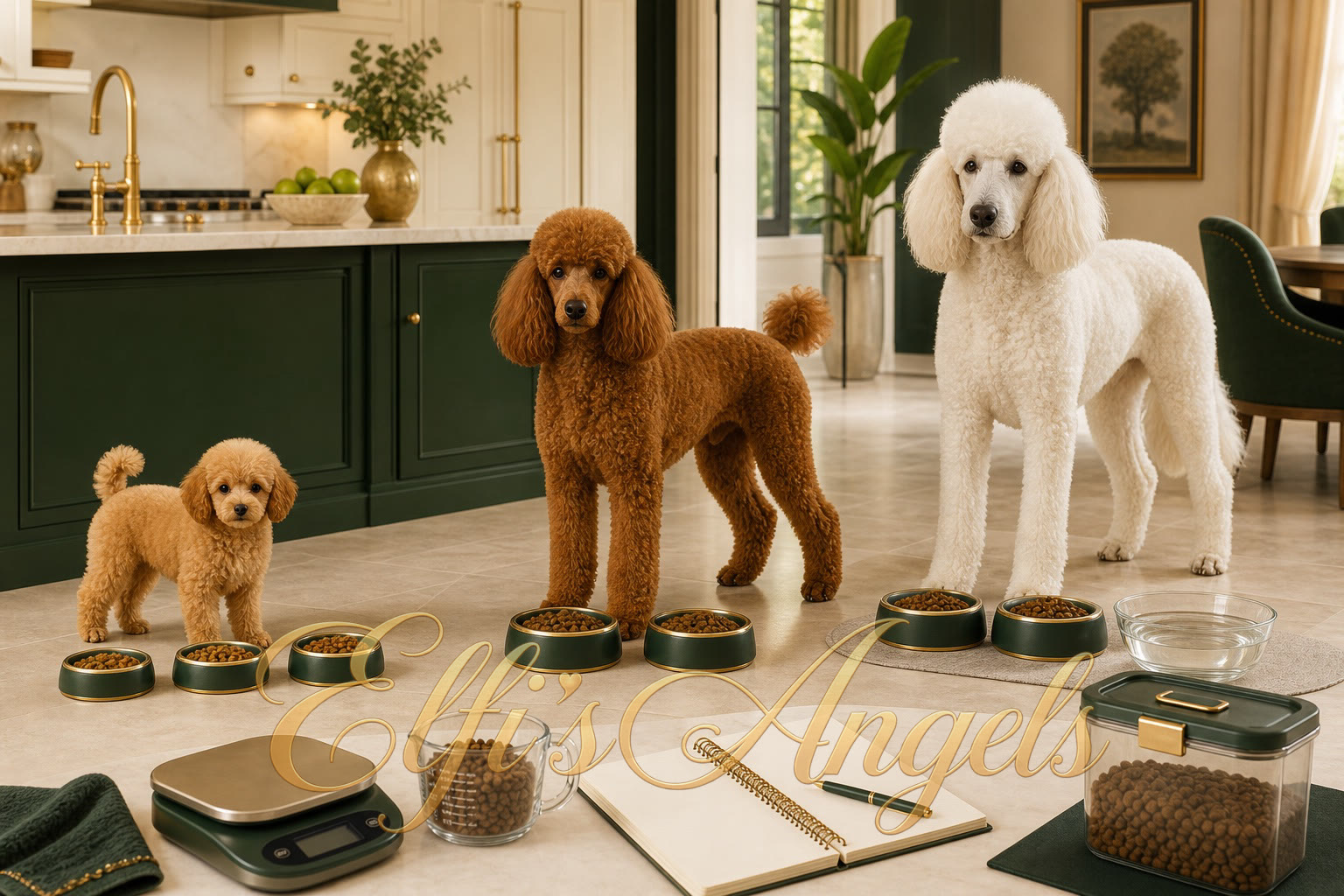
The feeding system at a glance
Start with the package’s feeding guide and the handover quantity, then treat both as a starting estimate. Calories per gram differ between foods, and two dogs of the same weight may need different amounts because of growth, neuter status, climate, activity and metabolism.
Use a kitchen scale. For a Toy Poodle, a small handful error can be a large percentage of the day’s calories. Record the total food, treats and chews rather than measuring only what enters the main bowl.
How to read a dog-food label in five checks
Find the nutritional-adequacy statement and confirm it covers growth, adult maintenance or the relevant life stage—not “intermittent or supplemental feeding only.”
Check calories per kilogram and per cup or serving so different foods can be compared by energy, not scoop size.
Confirm the manufacturer provides a complete nutrient analysis, quality-control contact and clear feeding and storage instructions.
Read the actual Indian-market bag because formula, calorie density and regulatory wording can differ between countries.
Ignore marketing words until adequacy, life stage, manufacturer expertise, safety systems and the dog’s response have been assessed.
ORIJEN Original pack guide: cups and grams for the whole day
On this ORIJEN Original pack guide, one cup is 120 g. Every number in the table is the total amount for one full day—not the amount for each meal. Divide the measured daily total into two adult meals. For example, a daily total of 120 g becomes two 60 g meals.
For a young puppy, continue the supplied ORIJEN Puppy quantity and usually divide the day into three meals. The Puppy pack uses current puppy weight and expected adult weight rather than the adult active/less-active table, so use the exact bag or calculator and the handover record. Do not apply the adult table to a 10-week-old puppy.
| Current adult weight | Less active: 1 hour or less exercise | More active: 1 hour or more exercise |
|---|---|---|
| 2–5 kg | ¼–½ cup / 30–60 g per day | ⅓–¾ cup / 40–90 g per day |
| 5–10 kg | ½–1 cup / 60–120 g per day | ¾–1¼ cups / 90–150 g per day |
| 10–20 kg | 1–1⅓ cups / 120–160 g per day | 1¼–2 cups / 150–240 g per day |
| 20–30 kg | 1⅓–2 cups / 160–240 g per day | 2–2¾ cups / 240–330 g per day |
| 30–40 kg | 2–2⅓ cups / 240–280 g per day | 2¾–3½ cups / 330–420 g per day |
A little Elfi’s note: Pack charts are starting points. Check the actual Indian-market bag because cup weight and formula can change, count treats, and adjust with the veterinarian to maintain lean body condition.
Elfi’s Angels recommended ORIJEN Original starting portions
These are Elfi’s Angels’ practical adult starting portions for ORIJEN Original. Watch the individual dog’s weight, waist, energy and activity, then move within the applicable less-active or more-active range when needed.
Do not reuse these cup or gram amounts for another food. Every food has its own calorie density, cup weight and feeding chart, so the correct portion can change even when the dog’s weight stays the same.
| Adult dog | Recommended for the full day | How to serve it |
|---|---|---|
| Toy Poodle | ½ cup / 60 g per day | Split into two adult meals. |
| Miniature Poodle | 1 cup / 120 g per day | Split into two adult meals. |
| Standard Poodle | 2 cups / 240 g per day | Split into two adult meals. |
| German Shepherd female | 2½ cups / 300 g per day | Split into two adult meals. |
| German Shepherd male | 3 cups / 360 g per day | Split into two adult meals. |
A little Elfi’s note: The amount shown is the whole day’s food, not the amount for each meal. Puppies continue the age-appropriate puppy-food chart and handover plan.
The nutrient details buyers usually miss
| Nutrient detail | Why it matters |
|---|---|
| Essential amino acids | Dogs need a complete pattern, including lysine, methionine, tryptophan and others; a crude-protein number cannot prove that pattern or digestibility. |
| Calcium–phosphorus balance | Both the absolute amount and ratio affect skeletal growth. Extra calcium can disrupt a complete puppy diet, especially in larger Standards. |
| Essential fatty acids | Linoleic acid and appropriate omega-3 sources support skin, coat and development; oil added by eye can unbalance calories and nutrients. |
| Fat-soluble vitamins | Vitamins A, D, E and K are necessary, but excessive supplementation can also cause harm. |
| Trace minerals | Zinc, copper, iodine, selenium, iron and manganese work in small controlled amounts; more is not better. |
| Energy density | A nutritionally complete food can still cause obesity when the portion supplies more calories than the dog uses. |
Changing food and reading the dog’s response
When a change is appropriate, mix increasing amounts of the new food over roughly a week; go more slowly for a sensitive dog. Do not change food, add several supplements and introduce new treats on the same day because the cause of a reaction becomes impossible to identify.
A short-lived mild stool change can follow stress or diet transition, but repeated vomiting, blood, black stool, marked diarrhoea, painful abdomen, lethargy, dehydration, weight loss or a young puppy refusing food needs veterinary advice. Do not repeatedly “reset” with incomplete chicken-and-rice meals without a clinical plan.
Treats, training rewards and chews
- Reserve part of the measured daily food for training whenever it motivates the dog.
- Keep treats and other unbalanced extras to roughly 10% or less of daily calories unless the veterinarian sets another target.
- Break rewards into tiny pieces; the dog counts repetitions, not reward size.
- Choose chews that cannot be swallowed whole or fracture teeth, supervise use and include their calories.
- Avoid cooked bones, fatty leftovers, xylitol, chocolate, grapes and raisins, onions and garlic, alcohol and other known toxins.
- Do not add calcium, multivitamins, fish oil or herbal products to a complete diet without checking the total dose and need.
Food storage and bowl hygiene in warm weather
- Keep dry food sealed in its original bag inside a clean container so the batch and best-before information remain available.
- Store away from heat, moisture, sunlight, insects and cleaning chemicals; do not mix a new bag into old crumbs.
- Wash bowls daily and discard wet or moistened food that has sat in warm conditions.
- Keep fresh drinking water available and wash the water bowl frequently.
- If food smells rancid, looks mouldy, is infested or the bag is damaged, stop using it and retain the package details.
The Elfi’s Angels difference
Your puppy comes home with a familiar feeding routine, and we explain the food, daily quantity and transition plan at handover.
Our puppies leave at about 10 weeks with clear KCI-related paperwork, familiar care information and direct handover guidance. We are based in Chennai and shipping across India, with availability confirmed personally for every family.
Quick answers
Things families ask us
What food should a Poodle puppy eat at 10 weeks?
Continue the measured ORIJEN Puppy handover plan initially, or the complete growth diet agreed with the breeder and veterinarian, to avoid an abrupt change.
When should I change from ORIJEN Puppy to ORIJEN Original?
There is no single date for all three Poodle sizes. Ask your veterinarian to review growth, body condition, activity and the exact product label before changing.
Can I feed only home food?
Yes only when a qualified veterinary nutrition professional has formulated a complete recipe and you follow its ingredient weights and supplement exactly.
Should I add calcium to puppy food?
Do not add calcium to a complete growth diet unless your veterinarian has identified and calculated a specific need.
How many meals should a 10-week-old Poodle eat?
The handover routine uses the measured daily amount divided into three small meals unless the veterinarian advises differently for that puppy.
Can I mix kibble and home food?
Small unbalanced toppers should remain within the treat-calorie allowance. If home food supplies a meaningful portion of calories, the whole combination needs professional formulation so nutrients and calories remain balanced.
How do I know if I am feeding too much?
Use hands as well as eyes: ribs should be easy to feel under a light covering, with a waist from above and abdominal tuck from the side. Track weight and ask the clinic to record body and muscle condition.
Does a senior Poodle automatically need low-protein food?
No. Seniors need muscle-preserving nutrition, and restrictions should be based on examination and medical findings. Age alone is not a diagnosis.
Want to see our sources?Breed clubs, veterinary guidance and feeding references used for this guide
- Guidelines on selecting pet foodsWorld Small Animal Veterinary Association
- Selecting the right pet foodAssociation of American Feed Control Officials
- ORIJEN Puppy product and feeding informationORIJEN
- ORIJEN Original product and feeding informationORIJEN
- Poodle (Toy) breed informationAmerican Kennel Club
- Canine life-stage preventive care guidelinesAmerican Animal Hospital Association
- ORIJEN Original daily ration feeding guideORIJEN