

An Indian guard dog can be athletic, capable and medium-sized. The Combai brings a watchful presence without needing the giant frame often associated with guarding breeds. Its appeal begins with character: a dog that notices its surroundings, forms relationships and has something useful to do.
That working heritage deserves a thoughtful place in modern life. A family farm, a villa courtyard and a compact independent home offer different opportunities. This guide looks at the breed’s story, the evidence behind its characteristics and the everyday choices that make a home suitable.
The quick answer
Start here
- A medium-sized Indian native working guard dog: athletic, watchful and closely involved with its people.
- A secure farm or villa offers useful space. A smaller home can work when the individual dog, daily routine and owner commitment fit.
- Professional reward-based training, socialisation and daily exercise are essential.
- Short-coated and straightforward to groom, with normal shedding and proper seasonal care.
- Combai and Kombai are two spellings of the same breed. Its origin is Combai, Tamil Nadu; its appeal reaches homes across India.
A working history rooted in everyday Indian life
The breed takes its name from Combai, also written Kombai, in Tamil Nadu. A 2023 TANUVAS field study describes its regional farm-guarding role and earlier hunting use. That is a practical working legacy shaped around people, land and daily tasks.
The history is most compelling when it is told honestly. A modern breed survey does not establish a single ancient founding date or authenticate every popular story about royal armies. We distinguish documented evidence from tradition rather than turning an appealing legend into a pedigree claim.
For a family choosing a dog today, the useful question is what that legacy asks of the owner. Give a watchful dog a clear place in household life, teach the boundaries and build trust through consistent handling. Native pride becomes meaningful when it leads to a better life for the dog.

A living legacy, with documented milestones
The Combai’s story continues through research and conservation. These recent milestones describe documentation and recognition, not the date the breed first existed.
| Milestone | What it tells us |
|---|---|
| 2023: TANUVAS field study | Researchers documented dogs and husbandry in the breeding tract. |
| 2025: native-dog conservation centre | TANUVAS records the inauguration of its centre conserving Kombai and other native breeds. |
| 7 August 2026: ICAR recognition | ICAR announced Kombai among newly recognised indigenous breeds. |
A little Elfi’s note: ICAR breed recognition and an individual dog’s KCI registration are different records. Neither alone establishes a particular puppy’s temperament, training or health.
Sources: TANUVAS researchers, Veterinary Practitioner ↗Indian Council of Agricultural Research ↗TANUVAS ↗
Medium-sized, athletic and short-coated
Think of an athletic medium-sized dog with a proportionate head and a useful, mobile build. The TANUVAS study describes a short reddish-brown or tan coat, black muzzle, drooping ears and a curved tail. Its measurements are observations of that study population, not guaranteed adult dimensions for every puppy.
| Reference | Males | Females |
|---|---|---|
| Average shoulder height | About 60 cm | About 56 cm |
| Average body weight | About 22.4 kg | About 21.7 kg |
| How to use the figures | A medium-size reference | Individual dogs vary |
A little Elfi’s note: The illustrations deliberately use standing adults for scale. Choose a dog for its actual structure, behaviour and fit with your home, rather than the apparent size in a dramatic photograph.
A watchful character needs a relationship
There is a difference between a dog that notices a visitor and a dog that can cope calmly while the owner opens the gate. In an everyday home, the second skill matters just as much. The aim is a confident companion that can look to you for guidance.
Our approach to choosing a Combai starts with the individual: parent behaviour, the puppy’s responses and the receiving family’s experience. A breed description is a starting point for those conversations. It cannot promise friendliness with every stranger, compatibility with every pet or a particular adult response.
Before choosing, describe your ordinary week. Who visits? Are there children, delivery workers, livestock or other dogs? Who will practise training? Those details tell us more about a possible match than a request for the most imposing-looking puppy.
Useful guarding begins with control
A sensible household goal is simple: notice something unusual, respond to the owner and settle when asked. Teach recall, loose-lead walking, waiting at doors and going to a resting place. Practise these skills before expecting them during an exciting arrival.
For example, the household can agree that the dog waits behind an internal gate while a parcel is delivered. The owner handles the interaction and rewards calm behaviour. This is a practical management example, not a promise that a particular puppy will perform a security task.
A puppy with guarding ancestry does not arrive as a trained protection dog. Deliberately provoking aggression creates a very different problem from developing a reliable family companion. Work with a qualified reward-based trainer, and involve a veterinary behaviour professional when fear or aggression needs assessment.
Life on farms and around farmhouses
A farm offers room for supervised movement and a day with changing activities. It also presents gates, vehicles, workers, neighbouring animals and places a dog should not enter. Treat that variety as a training plan rather than assuming open land will raise the dog for you.
Begin with a small, secure area and consistent routines. Introduce one part of the property at a time, with the dog under control. An owner walking a boundary with the dog is building a shared habit; leaving a new dog to patrol unfamiliar acreage is a different situation.
- Check fencing, gate latches, drains and gaps before arrival.
- Plan controlled introductions to regular workers and visitors.
- Keep tools, chemicals, machinery and vehicle routes inaccessible.
- Use barriers and supervised introductions around poultry and livestock; do not assume automatic compatibility.
- Provide shade, water, comfortable rest and daily family contact.
- Continue walks, play and training even when there is plenty of land.
A little Elfi’s note: These are practical property-management suggestions. A farm guard dog is not automatically a specialist livestock guardian, and every animal introduction needs individual assessment.
Can a Combai suit a small home?
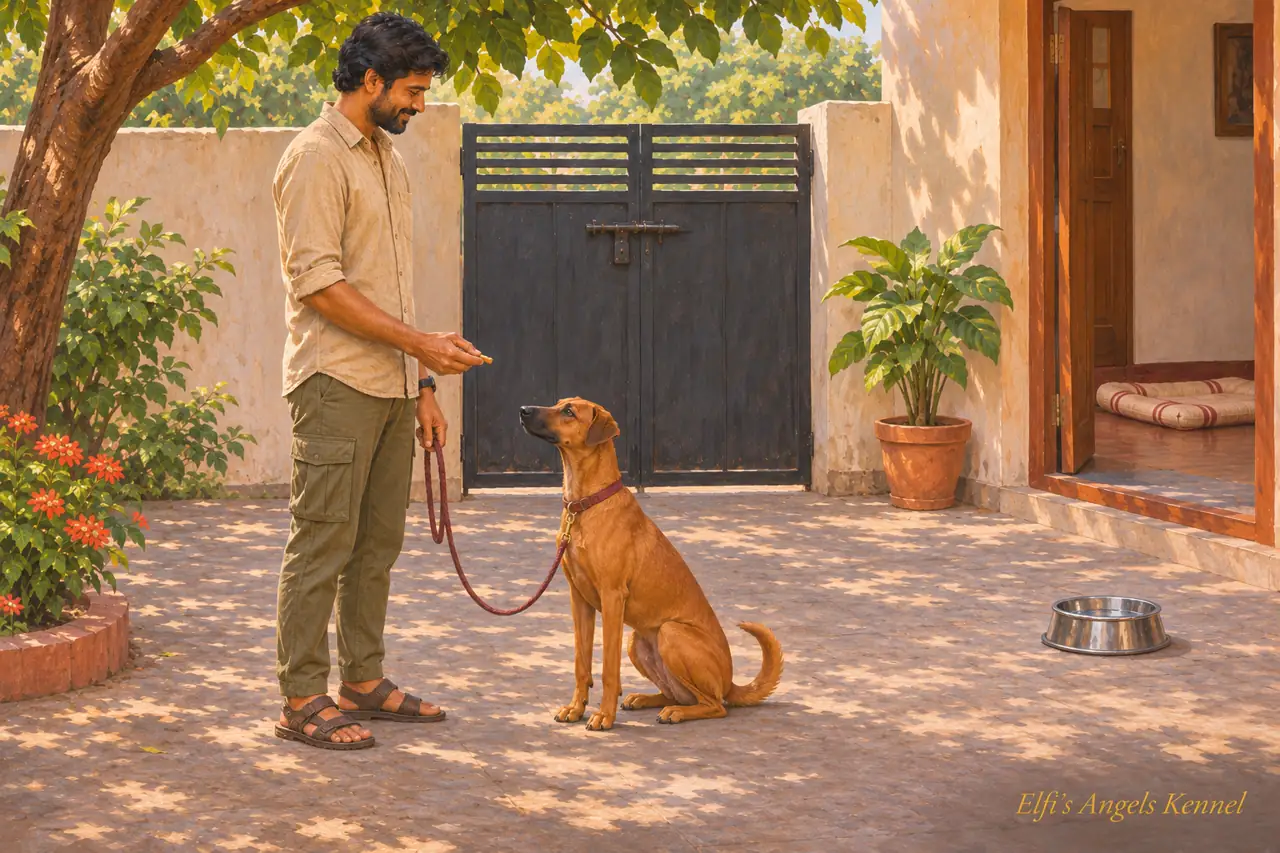
A smaller independent home can be a thoughtful match for the right medium-sized Combai. What matters is the life available around the floor plan: regular activity, easy toilet access, a comfortable resting place and owners who enjoy working with their dog.
Apartment suitability needs closer discussion. Consider shared lifts, corridors, noise, visitors and outdoor access. Dogs Trust advises assessing the individual dog’s behaviour, energy and needs alongside the home’s practical arrangements. Its advice applies to dogs generally; it is not a Combai-specific guarantee.
Imagine two homes. One has a large unused garden but nobody available to train or spend time with the dog. The other is smaller, with a secure entrance, a reliable walking routine and an owner who practises calm manners daily. Size alone would miss the most useful part of that comparison. This is an illustrative planning example, not a customer case or a rule that every small home will work.
Sources: Dogs Trust ↗
Compare the home, then examine the routine
| Home | Useful opportunity | Plan before choosing |
|---|---|---|
| Secure farm | Supervised outdoor activity | Boundaries, visitors, vehicles and animal separation |
| Villa or independent house | A garden or courtyard | Daily outings, gate manners and family time |
| Smaller home | A close household routine | Exercise access, rest space and time for training |
| Apartment | Possible for a suitable individual | Outdoor access, shared-space behaviour and professional advice |
A little Elfi’s note: Use this as an enquiry checklist. Home size, breed label and a photograph cannot establish suitability on their own.
Give the day movement, learning and rest
Daily exercise is essential. Combine appropriate walks and sniffing with play, short learning sessions and time to rest. RSPCA guidance emphasises regular activity and opportunities to engage; a dog left without enough to do can become bored or distressed.
There is no single exercise duration in this guide for every Combai. A young puppy, a fit adult and an older dog need different plans. Agree an age- and health-appropriate routine with your veterinarian and trainer, adjusting it to weather and the dog in front of you.
| Part of the day | What to include |
|---|---|
| Morning | Toilet access, appropriate movement and a short familiar training task |
| Daytime | Rest, water, toilet opportunities and planned human contact |
| Evening | A suitable outing or supervised play, plus engagement with the family |
| Before sleep | A final toilet opportunity and a predictable settling routine |
Sources: RSPCA ↗
Professional training is part of the commitment
We consider working with a trainer a must for a Combai home. Look for someone who explains their methods, helps the household practise and uses rewards to build the behaviour you want. AVSAB recommends reward-based methods for training and behaviour work.
Ask the trainer to help plan calm visitor arrivals, handling, walking and comfortable rest. Socialisation should be gradual and suitable for the individual, with puppy exposure coordinated with veterinary disease-risk advice. The owner needs skills too: noticing when the dog is comfortable, reducing difficulty and ending a session successfully.
Book support before the puppy arrives and continue as it matures. A short course cannot replace the household’s everyday consistency. The best plan is one that every responsible adult at home can understand and carry out.
Care for an Indian native dog across India
Across India, local conditions change. During hot weather, move activity to cooler times and provide shade and water. In cold or wet conditions, give a short-coated dog suitable protection and a dry, comfortable resting place. Native ancestry is a reason for pride, not an exemption from seasonal care.
The short coat still sheds. Plan routine brushing and checks of skin, ears, teeth and nails, with your veterinarian guiding preventive care. Look at the whole dog’s comfort and condition rather than expecting a low-maintenance label to make decisions for you.
Choose complete food appropriate to life stage and health, or use a home-prepared recipe formulated with a veterinary nutritionist. Cornell’s guidance stresses nutritional balance and gradual food changes. An Indian native breed does not have a special ability to thrive on every household meal.
Sources: RSPCA ↗RSPCA ↗Cornell University College of Veterinary Medicine ↗
Carry the legacy forward through responsible ownership
Choosing an Indian native dog can be a celebration of the country’s canine heritage. That choice becomes more valuable when it comes with careful parent selection, honest records and a lifetime plan for the individual dog.
For us, preserving a working breed’s appeal means describing both its strengths and the owner’s role clearly. A medium-sized build, a watchful presence and pride in an Indian breed are good reasons to start a conversation. Time for exercise, patient training and stable care are what turn that conversation into a workable home.
Ask what has actually been observed about the parents and puppy. Discuss your household openly. A considered match helps the family and gives the dog a better chance to belong, whether the address is a farmhouse or a smaller home.
Questions to bring to your Combai enquiry
Elfi’s Angels Kennel is based in Chennai and welcomes Combai enquiries from across India. Our programme page explains the current ₹60,000 plus transport offering, KCI registration, champion bloodlines and verified-parent selection. Current options and travel arrangements are discussed individually on WhatsApp.
The owner releases certificate copies and registration numbers after owner-verified payment or at handover. Before booking, ask ordinary questions about the registration process, the puppy’s suitability and how handover will work.
- What has been verified about the parents’ temperament, trainability and registration?
- How does the individual puppy respond to handling, new people and unfamiliar situations?
- How will my farm, smaller home, children or other animals affect the choice?
- Which trainer and veterinarian will support us locally?
- What are the current puppy price, separate transport charge and confirmed handover arrangements?
- What feeding and care information will be explained at handover?
Quick answers
Things families ask us
Are Combai and Kombai the same breed?
Yes. They are two spellings of the same Indian native breed. This guide uses Combai, while ICAR lists it as Kombai.
Is the Combai a medium-sized or large dog?
This guide presents the Combai as a medium-sized, athletic working dog. The illustrations use adults for scale; individual size should be assessed from the actual dog and its parents.
Why is the Combai known as a working guard dog?
Its documented regional history includes guarding farmland. In a modern home, that heritage needs appropriate selection, training and management; a puppy is not a trained protection dog.
Can a Combai live in a small house?
A suitable individual can fit a smaller home with secure access, daily activity, rest, companionship and consistent training. Discuss the actual household and dog before deciding.
Can a Combai live in an apartment?
Possibly, for a suitable individual and committed household. Outdoor access, shared spaces, noise, toilet routines and behaviour need careful assessment with a trainer.
Is a farm enough exercise for a Combai?
A farm gives space, but owners still need to provide daily engagement, training and appropriate exercise. Secure fencing, supervised exploration and managed animal introductions matter.
Does a Combai need a trainer?
Yes. Elfi’s Angels considers professional training essential. Choose reward-based guidance and practise consistently with the dog throughout its development.
Do Combai dogs shed?
Yes. A short coat still sheds and needs routine care. Combai should not be described as non-shedding or hypoallergenic.
Are the pictures real Combai puppies for sale?
No. Every illustration in this guide is AI-generated editorial artwork. None depicts an available puppy, a verified parent or a documented historical event.
Can families outside Chennai enquire?
Yes. Elfi’s Angels welcomes enquiries from across India. Share your city, home routine and preferred timeline to discuss suitability, current options and separate transport arrangements.
Want to see our sources?Breed clubs, veterinary guidance and feeding references used for this guide
- 2023 Kombai field study: origin, characteristics and rearing practicesTANUVAS researchers, Veterinary Practitioner
- Recognition of Kombai among indigenous breeds, 7 August 2026Indian Council of Agricultural Research
- Regional Centre for Conservation of Native DogsTANUVAS
- Humane dog training and choosing a trainerAmerican Veterinary Society of Animal Behavior
- Assessing a dog’s needs when living in a flatDogs Trust
- Training, regular exercise and a safe resting spaceRSPCA
- Keeping dogs safe during summerRSPCA
- Short coats and cold-weather careRSPCA
- Complete nutrition and home-prepared dietsCornell University College of Veterinary Medicine