
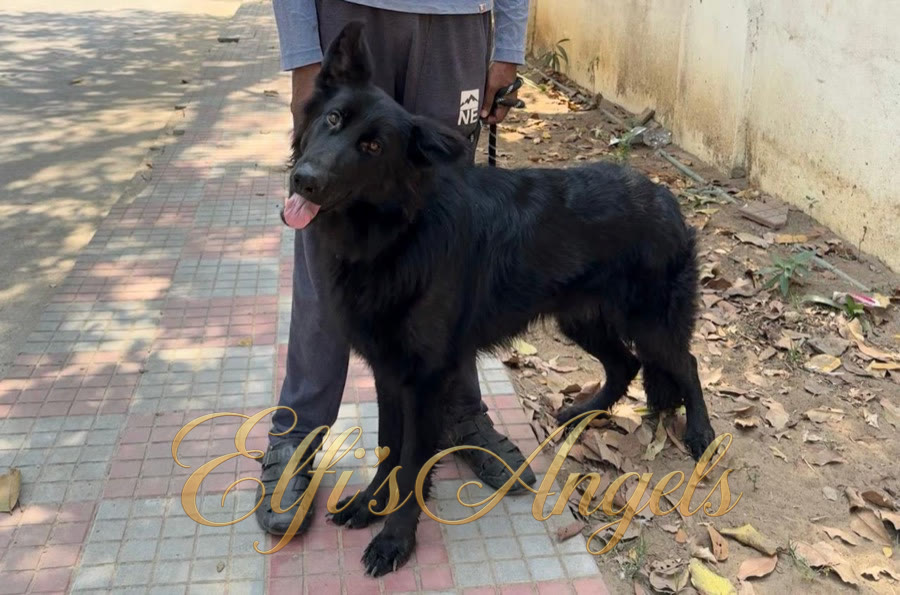
A well-raised German Shepherd is a deeply loyal family companion: intelligent, observant, eager to learn and happiest when life includes both affection and purpose.
At Elfi’s Angels, our Working Line programme is built around Draco and Gabi. Draco brings Czech working-line heritage and titled Romanian ancestry; Gabi is our black long-coat, straight-back mother with champion ancestry and a loving family temperament. Together, they represent the balance we value—confidence, trainability, sound structure and a beautiful life inside the family home.
The quick answer
Start here
- Typical adult female: 22–24 in / 56–61 cm and about 23–32 kg; male: 24–26 in / 61–66 cm and about 30–41 kg.
- Our parents are selected for stable family temperament, sound structure, real-world behaviour and trainability—not a label alone.
- Elfi’s Angels puppies are prepared for manners, family life and lifelong learning from the very beginning.
- Our programme combines controlled large-breed growth, hip-and-elbow-aware breeding decisions, coat-care guidance and continued training support.
German Shepherd characteristics
- Intelligent and highly trainable, with strong awareness of people and environment.
- Loyal and often naturally watchful; neutrality must be taught rather than encouraging indiscriminate suspicion.
- Athletic with substantial exercise and mental-work needs.
- Large and physically capable, making early leash, greeting and impulse-control skills essential.
- Double-coated and seasonally shedding, unlike a Poodle coat.
Working line and show line: what the names mean
“Working line” and “show line” are broad selection histories, not two separate breeds. Ask what the parents actually do, how they live, what health information exists and how their temperaments look away from a training field or show ring.
| Topic | Working-line emphasis | Show-line emphasis |
|---|---|---|
| Selection goal | Work capacity, nerves, drives, endurance and task performance. | Conformation to a show standard, movement, structure and breed type. |
| Daily intensity | Often higher; may need planned training jobs and experienced handling. | Still active and trainable; energy varies widely by family and breeding programme. |
| Appearance | Often more utilitarian and variable by regional working tradition. | More visually consistent within American, West German or other show traditions. |
| Best home | A structured home that enjoys training and can channel drive. | An active home that values temperament, structure and training. |
| What the label cannot prove | Health, stable temperament, suitability or actual working ability. | Health, stable temperament, suitability or quality of movement. |
A little Elfi’s note: At Elfi’s Angels, our Czech working-line foundation is chosen for stable family temperament, sound structure, real-world behaviour and trainability.
Home and family fit
A GSD can live indoors and should be integrated into family life, but it needs more activity and management than a typical small companion. An apartment requires reliable lift manners, neighbour neutrality, toilet access and multiple daily outings. A villa or yard does not replace walks or training.
Children and dogs must always be supervised. Give the dog a protected rest place, teach children not to climb, hug, disturb food or wake a sleeping dog, and reward calm interactions.
How big will a German Shepherd be—and how much does an adult eat?
| Adult reference | Typical weight | Less active adult | Recommended starting portion | More active adult |
|---|---|---|---|---|
| Female: 22–24 in / 56–61 cm | About 23–32 kg | 1⅓–2⅓ cups / 160–280 g per day | 2½ cups / 300 g per day | 2–3½ cups / 240–420 g per day |
| Male: 24–26 in / 61–66 cm | About 30–41 kg | 2–2¾ cups / 240–330 g per day | 3 cups / 360 g per day | 2¾–4 cups / 330–480 g per day |
A little Elfi’s note: Elfi’s Angels recommends 2½ cups / 300 g for an adult female and 3 cups / 360 g for an adult male as practical starting portions when feeding ORIJEN Original. Each quantity is the full day’s amount, split into two adult meals. Portions vary for other foods because calorie density and feeding charts are different.
Training and stimulation
Begin name response, recall, handling, toilet routine and engagement immediately.
Teach loose-leash walking and four-feet-on-the-floor greetings before adult strength arrives.
Socialise for calm neutrality around people, dogs, traffic and novel environments—not forced greetings.
Use scent work, tracking foundations, obedience, retrieving and controlled play to channel working instincts.
Seek a qualified reward-based professional early for fear, guarding, reactivity or unsafe behaviour.
Exercise without overloading a growing body
Adult German Shepherds generally need substantial daily movement and purposeful activity. Puppies need frequent short exploration and training, not forced running, repetitive jumping, slippery-floor chasing or long-distance exercise.
Keep the puppy lean, provide floor grip and ask the veterinarian about growth, gait and age-appropriate conditioning. Sudden lameness, reluctance to rise or an altered gait needs examination.
Food and nutrition
Feed a complete growth diet appropriate for a large-breed puppy and measure it to maintain lean body condition. Large-breed skeletal development depends on controlled calories and mineral balance; adding calcium to a complete diet can be harmful.
Home-prepared food must be formulated by a qualified veterinary nutrition professional. Muscle meat, rice and vegetables do not by themselves supply the full amino-acid, fatty-acid, vitamin and mineral profile.
- Use three measured meals for a young puppy unless the vet advises otherwise, later moving to two.
- Avoid vigorous exercise immediately around large meals and discuss bloat risk with your veterinarian.
- Monitor body and muscle condition beneath the coat, not appetite alone.
- Change food gradually and investigate persistent stool or skin problems medically.
Grooming and routine maintenance
| Area | Routine |
|---|---|
| Double coat | Brush regularly and more often during seasonal shedding; do not shave a healthy double coat for heat. |
| Bathing | Bathe as needed with dog-safe products and dry fully. |
| Ears | Inspect weekly; pain, odour, discharge or redness belongs with the vet. |
| Nails | Check weekly and trim before they affect stance or movement. |
| Teeth | Build toward daily brushing with dog toothpaste. |
| Skin and ticks | Part the dense coat to inspect, and use veterinarian-selected parasite prevention. |
Vaccination and medical follow-up
Continue the core puppy vaccination series from the supplied record through the veterinarian’s final puppy dose, commonly at 16 weeks or later under WSAVA guidance. Plan rabies according to law and product label, and assess leptospirosis and other vaccines by local and lifestyle risk.
Discuss parasite prevention, body condition, hips and elbows, gait, skin, ears, digestion and reproductive planning. No pedigree title or line label replaces individual health assessment.
Potty training
Use the same schedule principles as for any puppy: immediately after waking, meals, drinking, play and crate time. A bathroom or secure balcony tray can be useful in a high-rise, but it must be large and strong enough for a rapidly growing dog.
Move calmly to one place, use one cue, reward immediately and clean accidents without punishment. Add an outdoor route once the veterinarian clears the disease risk.
Before and after the puppy arrives
- Before: secure gates and balconies, add non-slip flooring, choose a large-breed crate, book a vet and trainer, and agree on family rules.
- Arrival day: offer the familiar food, water, toilet access and sleep; avoid crowds and dog parks.
- After one quiet day: complete an independent vet examination with records.
- First weeks: prioritise engagement, calmness, handling, socialisation and controlled alone time.
- Adolescence: continue training when confidence, strength and environmental interest increase.
Children, visitors, cats and other dogs
German Shepherds can be devoted family dogs, but size, speed and watchfulness require adult management. Children should not climb, hug, disturb sleep or take food and toys. Teach a place cue and use gates so visitors can enter without crowding the dog.
Introduce cats and dogs gradually with distance, barriers and parallel activity. Prevent chasing. The goal around unfamiliar people and animals is calm neutrality and handler focus, not a demand to greet everyone.
Training roadmap from 10 weeks to two years
| Age period | Priorities |
|---|---|
| 10–16 weeks | Safety, socialisation, name, recall, handling, crate, toilet, food manners and brief positive play. |
| 4–9 months | Loose lead, impulse control, settle, reliable recall foundations and calm exposure as confidence grows. |
| 9–18 months | Continue skills through adolescence; manage strength, chasing, barking and environmental distraction. |
| 18–24+ months | Build mature conditioning and chosen work or sport gradually; maintain neutrality and household manners. |
Indian heat and the double coat
- Exercise in the coolest hours, carry water and shorten work when humidity prevents effective cooling.
- Provide indoor cooling, shade and fresh water; never use a balcony, rooftop or parked car as daytime housing.
- Brush out loose undercoat regularly and more often during seasonal shedding.
- Do not shave a healthy double coat as a heat shortcut; coat removal does not make hot surfaces or midday exercise safe.
- Stop for heavy panting, slowing, weakness, confusion, vomiting or collapse and seek urgent veterinary help.
Why families choose our Working Line GSD programme
- Draco brings Czech working-line heritage, a Romanian sire and titled ancestry to the programme.
- Gabi is our beautiful black long-coat, straight-back mother with champion ancestry and a loving family temperament.
- We select for confident family temperament, sound structure, real-world behaviour and trainability.
- Our puppies begin with home life, handling, manners, age-appropriate enrichment and a steady introduction to the world.
- We guide families on lean large-breed growth, coat care, training progress and the questions to continue with their own veterinarian.
- Puppies are handed over with clear paperwork and ongoing support from our Chennai kennel, shipping across India.
A little Elfi’s note: Our goal is a German Shepherd who looks impressive, learns eagerly and—most importantly—belongs beautifully in family life.
Quick answers
Things families ask us
What makes the Elfi’s Angels Working Line GSD special?
Our programme combines Draco’s Czech working-line and titled Romanian ancestry with Gabi’s black long-coat beauty, straight-back structure, champion ancestry and loving family temperament. We are building confident, trainable companions prepared for real family life.
Can a German Shepherd live in an apartment?
Yes, but only with reliable daily outings, training, mental work, neighbour-safe manners, toilet access and management of a large active dog.
Should I give calcium to a GSD puppy?
Do not add calcium to a complete large-breed growth diet unless the veterinarian has calculated a specific requirement.
Do German Shepherds need professional grooming like Poodles?
They do not need Poodle-style clipping, but their double coat sheds and requires regular brushing, bathing as needed, nails, ears, teeth and skin checks.
What is the adult height and weight of a German Shepherd?
A typical female is about 22–24 inches (56–61 cm) and 23–32 kg; a typical male is about 24–26 inches (61–66 cm) and 30–41 kg. Individuals vary.
How much should an adult GSD eat per day?
On the cited ORIJEN Original guide, the amount depends on current weight and activity—for example, a 30–40 kg adult starts around 240–280 g less active or 330–420 g more active for the entire day, split into two meals. Adjust to body condition.
Is a show-line GSD calm enough for any family?
Look at the individual dog’s temperament and daily activity needs. We help families choose a companion and plan the training, exercise and home routine that suits them.
When does a German Shepherd mature?
Physical and social maturity develops over years, not at the first birthday. Continue structured training and controlled conditioning through adolescence and into adulthood.
How much exercise does a GSD puppy need?
Use frequent short exploration, play and training rather than forced running or repetitive jumping. Let the veterinarian guide conditioning as growth and joints develop.
Want to see our sources?Breed clubs, veterinary guidance and feeding references used for this guide
- German Shepherd Dog breed informationAmerican Kennel Club
- Guidelines on selecting pet foodsWorld Small Animal Veterinary Association
- 2024 guidelines for vaccination of dogs and catsWorld Small Animal Veterinary Association
- Core and non-core canine vaccine recommendationsAmerican Animal Hospital Association
- How to potty train a puppyAmerican Kennel Club
- How to groom a dog at homeAmerican Kennel Club
- German Shepherd Dog breed standard and temperamentGerman Shepherd Dog Club of America
- German Shepherd puppy training timelineAmerican Kennel Club
- Canine life-stage preventive care guidelinesAmerican Animal Hospital Association
- Puppy socialisation position statementAmerican Veterinary Society of Animal Behavior
- ORIJEN Original daily ration feeding guideORIJEN